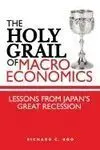
The Holy Grail Of Macroeconomics
The Holy Grail Of Macroeconomics
Koo, Richard C
How did the great Depression of the 1930s get to be so bad for so long? That question has baffled economists for decades. Ben S. Bernanke, the current Fed Chairman, even called understanding the great Depression the as yetunattained holy Grail of Macroeconomics. Japan`s Great recession of 19902005 finally gave us some vital clues as to how a postbubble economy can plunge into...
Sinopsis
How did the great Depression of the 1930s get to be so bad for so long? That question has baffled economists for decades. Ben S. Bernanke, the current Fed Chairman, even called understanding the great Depression the as yetunattained holy Grail of Macroeconomics. Japan`s Great recession of 19902005 finally gave us some vital clues as to how a postbubble economy can plunge into prolonged recession while leaving conventional policy responses largely ineffective. Building on the author`s earlier work Balance Sheet Recession: Japan`s Struggle with Uncharted Economics and its Global Implications (John Wiley, Singapore, 2003), The Holy Grail of Macroenomics: Lessons from Japan`s Great Recession argues that there are actually two phases to an economy, the ordinary (or yang) phase, in which the private sector is maximizing profits, and the postbubble (or yin) phase, in which private sector is minimizing debt, or repairing damaged balance sheets. Although conventional economics is useful in analyzing economies in the yang phase, it is less useful in explaining phenomena such as the liquidity trap that is typical of an economy in the yin phase. The distinction between the yin and yang phases also explains why some policies work well in some situations but not in others. Indeed, it offers the crucial foundation to macroeconomics that has been missing since the days of Keynes. This groundbreaking book not only explains what happened to the U.S. during the Great Depression and to Japan during the Great recession, it also offers important policy recommendations for fighting postbubble economic downturns in any country, including the current subprime crisis in the U.S.
Comentarios
Sé el primero en comentar este libroArtículos relacionados