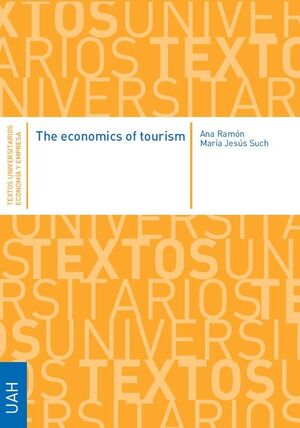
SUCH,MARÍA JESÚS / RAMÓN RODRÍGUEZ, ANA
Preface.
Chapter 1. Introduction.
1. Contextualisation.
2. The economics of tourism and the challenges of the 21st century.
3. Overview of chapters.
Chapter 2. Tourism demand.
1. Analysis of demand.
2. Determinants of tourism demand.
3. Segmentation.
4. Tourism demand in Spain.
Conclusions.
Key terms.
Exercises and activities.
Bibliography.
Chapter 3. Tourism supply.
1. Introduction.
2. Tourism supply function, elasticity, costs and other factors.
3. Analysis of tourism supply.
Conclusions.
Key terms.
Exercises and activities.
Bibliography.
Chapter 4. Market structure, equilibrium in the tourism sector and market failures.
1. Introduction.
2. The structure of the market.
3. The equilibrium of the tourism market.
4. Market failures.
Conclusions.
Key terms.
Exercises and activities.
Bibliography.
Chapter 5. Measuring the tourism activity: the economic impacts of tourism.
1. Introduction.
2. Macroeconomic aspects of tourism.
3. Measuring tourism activity.
4. The balance of payments and tourism.
Conclusions.
Key terms.
Exercises and activities.
Bibliography.
Chapter 6. tourism policy and Public Intervention in tourism.
1. Introduction.
2. Government, tourism policy and tourism administration.
3. Tourism policy within a framework of goals, objectives and instruments.
4. Tourism policy and endogenous local and regional development.
5. Tourism policies and territory: strategic planning.
Conclusions.
Key terms.
Exercises and activities.
Bibliography.
Chapter 7. globalisation and tourism.
1. What is globalisation?
2. Characteristics and factors that drive international tourism.
3. Global expansion and tourism.
4. COVID-19, impact on tourism.
Conclusions.
Key terms.
Exercises and activities.
Bibliography.
Chapter 8. innovation in the internationalisation of tourism companies.
1. The internationalisation of tourism companies. The process of economic globalisation and multinationals.
2. New scenario, competitive pressure, new technologies and changes in demand.
3. Changes in ways to compete in the tourism sector in response to globalisation.
4. The global tourism value chain.
Conclusions.
Key terms.
Exercises and activities.
Bibliography.
Chapter 9. Competitiveness, sustainability and smartness in tourism: the fundamental role of human capital.
1. Introduction.
2. What is tourism competitiveness?
3. The competitiveness of tourist destinations and its measurement.
4. The competitiveness of the tourism industry.
5. Competitiveness in tourism companies and general competitive strategies.
6. Competitiveness, sustainability and tourism smartness.
Conclusions.
Key terms.
Exercises and activities.
Bibliography.
Chapter 10. Innovation and digital disruption in tourism. From ICTS to the age of artificial intelligence.
1. Introduction.
2. How much does the tourism sector innovate?
3. Tourism's response to the challenges of the digital economy and artificial intelligence.
4. New tourism in the age of artificial intelligence.
Conclusions.
Key terms.
Exercises and activities.
Bibliography.
Chapter 11. Environmental economics, , externalities, and the circular economy.
1. Tourism and the environment.
2. The externalities of the tourism activity.
3. Natural resources and responsible tourism.
Conclusions.
Key terms.
Exercises and activities.
Bibliography.
Answers.
This is a rigorous text that addresses the Economics of Tourism through a comprehensive reading of all the areas covered by the tourism industry, with real-world examples. It is a collective work by authors, teachers, and researchers of Applied Economics from different Spanish universities. They have done an excellent job using understandable language that benefits undergraduate and postgraduate students dealing with tourism economics in different courses.
It covers the fundamentals of the economics of the tourism industry with an engaging style, applied to a wide range of topics related to the tourism sector. It concerns consumers, suppliers, and all the stakeholders at international levels, using basic examples to contextualize theory in the tourism wo ...
María Jesús Such Catedrática de Economía Aplicada del Departamento de Economía de la Universidad de Alcalá. Miembro del Instituto de Análisis Económico y Social de la UAH. Es coordinadora del grupo «Análisis del Sector Turístico e Innovación» [ATURI] y ha liderado la cátedra One Shot Hotels para la innovación turística. Asimismo, colidera la Cátedra Guadalajara Destino Turístico Inteligente y la Cátedra Engie de Sostenibilidad, Cambio Climático y Transición Energética.